Saturday, August 14, 2010

Life of Pi: First Impressions


I decided to go with Life of Pi because for whatever reasons I am still procrastinating LOTR. I have read the first seven chapters, which takes me approximately 8% through the book. So far this book is about an Indian boy who was named after a pool and enjoys swimming. Thrown in there as well is a defense of zoos, which I found very interesting.

Pi's father runs a zoo, so he takes a few pages telling his reader why zoos are not as inhumane as people believe them to be. He starts by saying that zoo enclosures are to animals what houses are to people; a condensed environment that has everything necessary all in one location. Both bring security to its inhabitants. While Pi recognizes that people think animals should be out running free, he believes that the animals have everything they need in the zoo, including abundant food and lack of predators. He also cited examples where animals who had escaped their enclosures eventually returned to them because that was their home. In the wild, Pi notes that predators are around, animals are always fighting over turf, and food is scarce. The zoo solves all of those problems for animals. He also says that the animals have rituals that they do daily, and noticing a change in the pattern and timing can help alert a zookeeper that an animal is feeling ill or that something is wrong. It was a very interesting and compelling argument, and while I agree with much of what Pi argues about zoos, I also believe that most animals belong in the wild.

Some quotes I especially liked:

p. 6 "I have nothing to say of my working life, only that a tie is a noose, and inverted though it is, it will hang a man nonetheless if he's not careful."

WORKAHOLICS BEWARE!!

p. 19 "The Pondicherry Zoo doesn't exist any more. Its pits are filled in, the cages torn down. I explore it now in the only place left for it, my memory."

Connection to my life: I attended a high school that was in pretty rough shape, and although it was not the best conditions for learning (windows that were welded open so the snow could come in, the smallest gym and auditorium in the county, cafeteria not able to fit all the students assigned to lunch at that time, no track, trailers outside for extra classroom space, etc.) it holds a special place in my heart because despite its flaws it had character. Sure, I got snowed on almost daily for a few months during English class, but eventually such frustrations became jokes. It did not have the facilities to compare with the other area high schools, but it was my school. In my senior year, the district started a fairly intense renovation project that began to change the look and layout of the school. The floors and ceilings were stripped, sections of the school became forbidden due to men in haz-mat suits getting rid of asbestos, and lights were dangling from wires giving the look of a mine shaft. This too, became more character for the school. They ripped up the parking lot, the fields, the hallways. There were construction vehicles all over the place. Our homecoming game was a home game an hour away because we didn't have a football field. My sports team played at an elementary school instead of the field normally used. For graduation, we wanted to wear hard hats. Anyway, you get the picture. The last memories of me at my high school included this construction vehicle, mine shaft, dust and gravel picture in my head.

The picture in my head does not exist anymore. My freshman year of college, the rebuilding of the school began. A wing was added, the gym was changed, the library moved into the auditorium, the auditorium moved into the old gym, there was a new gym wing built out the back, the bus loop changed from the front of the building to the side, and the old back of the school was now the front. There is a state of the art track with a football field inside and new bleachers and a circular amphitheater in front. The old trees and ivy covered brick is gone and was replaced by a monster that has no resemblance to the old school and does not fit the location anymore (in a historic village). For this reason, I do not go in the school and prefer to remember it as it was. My younger sister attended this school too, but the updated version. If I was forced to attend something at the school, a concert or game, perhaps, I had to force myself to pretend that she was going to a different school, and that this school was not mine. For some reason this made me feel better, even though I know it is irrational and it's the same school only renovated with none of the charm of the old building. So, from this very long digression, I can understand what Pi is going through with his zoo from his childhood gone. And although this quote, very short and at the end of the chapter, hardly amounts to much, I am made to believe that it causes him great pain.

So, that was a longer and way more involved entry than I meant to write, but from this I think it's clear that Life of Pi is going to be a very thought provoking book. The Author's Note claimed that it was a story to make you believe in God. (I'll be honest, I don't really know what I believe. I know that organized religion is not for me, that praying seems irrational, and that you have to work hard and not take for granted that someone will help you out. However, I'm convinced that coincidences don't exist and that ghosts are real.) So, this book is clearly going to take on religion as a topic, which will be interesting given that Pi studies religion as well as zoology at university. Religion discussed with science will be something interesting and new for me, and it will be interesting how Pi will be able to balance these two partially opposing ideas.

Anyway, that's the beginning of Life of Pi. I'm anxious to keep reading. It'll be dense and thought provoking but I hope enjoyable at the same time.

Friday, August 13, 2010

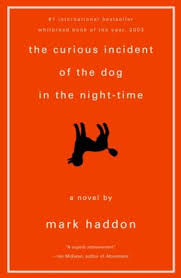
The Curious Incident of the Dog in the Night-Time

I just finished reading 'The Curious Incident of the Dog in the Night-Time.' This book, besides being a fabulous vacation book (defined as interesting, small, and not a page turner that has you reading all of vacation when you are supposed to be out and doing things), was a really interesting book that had a lot of new perspectives on many different things. I realize that is vague, so I'll go into a little more detail. Essentially, this is the story of a teenage boy who sets out to figure out who has stabbed his neighbors dog. In the process, his story becomes one of family and truth and independence. I'm sure there are a lot of stories like this. However, this book is told in the first person by a teenage male speaker with autism. I think the fact that I am a special ed teacher drew me into the book, but you do not have to have any background in autism to appreciate the book. The speaker, Christopher, tells his story of his investigation into who killed his neighbor's dog. However, about half the chapters have nothing to do with his story. Instead, they are about math problems, his beliefs about various subjects like science and math, and his past. Christopher is an extremely logical person who does not dwell on sadness and has very unique and not always acceptable ways of dealing with his problems. Here are three quotes I especially liked:

"All the other children at my school are stupid. Except I'm not meant to call them stupid, even though that is what they are. I'm meant to say that they have learning difficulties or that they have special needs. But this is stupid because everyone has learning difficulties because learning to speak French or understanding relativity is difficult and also everyone has special needs, like Father, who has to carry a little packet of artificial sweetening tablets around with him to put in his coffee to stop him from getting fat, or Mrs. Peters, who wears a beige-colored hearing aid, or Siobhan, who has glasses so thick they give you a headache if you borrow them, and none of these people are Special Needs, even if they have special needs" p. 42=43

"Mr. Jeavons said that I liked maths because it was safe. He said I liked maths because it meant solving problems, and these problems were difficult and interesting but there was always a straightforward answer in the end. And what he meant was that maths was not like life because in life there are no straightforward answers in the end." p. 61-62

"And whenever I thought about the future I couldn't see anything clearly in my head and that made a panic start. So Siobhan said I shouldn't think about the future. She said 'Just think about today. Think about all the things that have happened. Especially about the good things that have happened.'"

Those excerpts give an accurate look at the writing style of the book. It is easy to follow along but sometimes when Christopher starts to explain math problems it gets a little tough, although I understood most of those parts. Additionally, they were not vital to the story so if it was problematic those parts could be skimmed or skipped.

So, interesting perspectives, unique protagonist, chapters labeled by prime numbers, etc. Pretty cool stuff in this book. I highly recommend. And I'm ranking it between Anne of Green Gables and Alice's Adventures in Wonderland.

Next up: ? Before vacation, I was thinking about resuming Lord of the Rings with The Two Towers, but I think I'm still in the mood for something lighter. And after reading Haddon, I think I'm in the mood for another coming of age type story. So, I may start instead with Life of Pi. Although there are still a great many books that are on my shelf that have yet to be read so you never know...

Sunday, August 1, 2010

Books I've read to date (and their ranking order)

I am 17% done with this list (as in, I have read 17 books from the list). I feel like after finishing Gone With The Wind I am accomplished and victorious and almost done but that is far from the case. As far as Gone With The Wind is concerned, 17% is 176 pages in where Scarlett just becomes a widow and moves to Atlanta and hardly anything has happened yet! Clearly I have a LONG way to go (especially considering that some of the list items are multiple books, such as Lord of the Rings, Narnia, and His Dark Materials). Now that I think of it, I read Gone With The Wind as a break from Tolkien but it may be several books before I return to LOTR because it's so dense. Even though Gone with the Wind was long, it did not require a ton of concentration.

My next book, from the list, anyway, (I have a couple that a friend gave me to read that are not on there) will be #59 The Curious Incident of the Dog in the Night by Mark Haddon, which I have deemed worthy of bringing on an airplane. It looks interesting, sounds interesting, reads quickly, has pictures, equations, and diagrams, and last but not least has a cutout of a dog on the front cover. If that doesn't scream fun book, nothing does! And the narrator has Autism, which will be interesting for me because I am a teacher and a nanny and that kind of thing interests me. I love that this list has some contemporary books, like that one and the Lovely Bones to break up all the Dickens and Austen and Steinbeck.

Another one(s) I may be tackling simultaneously is/are #33 and #36 Chronicles of Narnia/The Lion The Witch and The Wardrobe, which is a part of the Narnia series. I have those on books on tape from the library which I may be listening to on vacation or perhaps when I'm exercising. (I did that to finish the Great Gatsby and it worked out pretty well.) I'm also thinking a plane ride coast to coast is the perfect opportunity to watch Gone With The Wind as a reward for my accomplishment.

Ok! Without further ado, here is my list from favorite to least favorite. From now on when I finish a book I will be ranking it on this list as well so that when I finish this project I'll have all the books in order. Here it goes:

21 Gone With The Wind
31 Anna Karenina
4 Harry Potter Series
5 To Kill A Mockingbird
7 Wuthering Heights
40 Winnie The Pooh
42 The Da Vinci Code
46 Anne of Green Gables
29 Alice's Adventures in Wonderland
9 Charlie and the Chocolate Factory
16 The Hobbit
22 The Great Gatsby
94 Watership Down
98 Hamlet
6 The Bible
70 The Inferno
61 Of Mice And Men

It was actually harder than I thought trying to figure out which books I liked more than others, especially in the middle, and especially since I read some of them a long time ago. But here it is for now, and others will be added as I finish. Eventually I'll publish the revised list with the extra books my friend and I added that we thought should be included in this list but were not for some reason. I know of a few of them, but once that gets finalized, that will be up here too, and probably in the list section on the right of this entry. But I won't think about that now, I'll think of that tomorrow, when I can stand it :)

Saturday, July 31, 2010

Victoire!

VEEK-TWAR!! (yes, my high school did in fact expose me to French class bingo)

I have finished all 1037 pages of Gone With The Wind. Actually, I finished yesterday and started writing an update, but I had to stop for some reason and now it is lost. Anyway, I ABSOLUTELY LOVED this book. Even though the last hundred or so pages were pretty rough, I still enjoyed it. In fact, I think this may be one of my favorite books of all time. Next entry I'll list the books I have read in the order that I liked them.

ANYWAY I'm not really in the mood to do a huge character analysis or anything like that, so I think today I will be agreeing or disagreeing with Sparknotes in my interpretation of the book, characters, themes, etc.

Sparknotes says that Scarlett embodies the South from pre-war days, through war days, and then through reconstruction as she changes from belle to widow to rich businesswoman. Ashley is supposed to be the old south and Rhett the new south. This all makes sense to me. But what about when Rhett walked out on the second to last page? The New South left Scarlett? hmm.....that is not making as much sense anymore. I prefer to think of it as Ellen representing the Old South, as well as Bonnie. Ellen's manners, habit of never having her back touch the back of a chair, keeping the books on the plantation, and nursing the sick show the charm of married women in the old south. However, during the war, the Old South dies and thus so does Ellen. Bonnie, named after the Bonnie Blue of the Confederate flag, also shows the old south. She is spoiled, shown off, and comes from a wealthy family. Even though she is born and raised in the New South, Rhett, treats her like a belle and expects her to be one as she grows up. She also resembles Gerald, who is another reminder of the old times. She too dies, showing the collapse of that sort of society. The fact that she dies in the same way that Gerald does is no coincidence either and draws more attention to the old days, especially with the flashback Scarlett has as Bonnie is jumping the gate.

I read the rest of sparknotes and in general it was on target, while at the same time a little sparse.

I'm not really sure what else to say...I've typed this entry at least twice because it kept getting erased/internet crashed. I admire Scarlett's perseverance in the face of her world crashing around her and everyone she loves leaving her. I admire Rhett's nonchalance and habit of stating things as they are. And I admire Mammy for stating things as they are as well, and controlling Scarlett, who is controlled by no one.

Overall, a great book, exciting read, highly recommend. The end. Tomorrow is another day.

Tuesday, July 27, 2010

Gone with the Wind: 80%

Less than 200 pages to go!

I feel very accomplished but I love the story so much that I wish it were several more thousands of pages. I love the style of writing, the characters, the details and the way that everything is connected. Scarlett ended up in Atlanta begging Rhett for money, trying to sell herself, and eventually got married to Frank Kennedy because he had money. She then bought a couple of sawmills and ran them to make money. One day on the way to one of the mills, she got attacked and Frank ended up dead trying to avenge the attack as part of the Ku Klux Klan. Scarlett was sorry, not that she had killed Frank (indirectly), but that she was going to hell. Then Rhett proposed to her while Frank was dead in the parlor. Ridiculous.

I LOVE THIS BOOK!!!! I'm sad I only have a couple hundred pages to go :(

There's not much to say about this section, although I was drawing parallels between Scarlett and Gatsby in terms of getting a plan to make money and doing anything to make that happen. Both, now that I think about it, are in love with someone who is married. But Scarlett carries through with her goal and having known hunger never wants to be without money.

However, I am not sure why she is blaming herself so much for Frank's death. While I understand that she disobeyed him when he asked her to stop going out to the mills because it was unsafe. Scarlett, in turn, talked to Frank to make sure he was not part of the Klan. Therefore, both disobeyed the requests of the other, and both got hurt for it. Unfortunately Frank didn't make it out of his attack alive, but in my opinion it was not solely Scarlett's fault that he had been killed. If he had listened to Scarlett, he would not have been involved in the Klan. At the same time, if Scarlett had not visited the mill, she wouldn't have been attacked. Perhaps being a gentleman, Frank had to seek revenge, but Scarlett did not want that either; on the evening of her attack she wanted Frank to stay home and comfort her. Therefore, I believe Frank's death is just as much Frank's fault as Scarlett's.

I'll be honest. I have seen the movie start to finish at least twice, but have watched the first half and the last 5 minutes many times. Therefore, the ending piece is a little fuzzy. I'll watch the movie at some point after finishing the book. I can remember parts from the movie as they happen in the book but I can't remember details much, especially related to the Scarlett and Rhett marriage, which consumes part 5, where I am now in the book. I remember that they lived richly, had a child who died, Rhett got drunk and pushed Scarlett down the stairs, and of course the "Frankly, my dear, I don't give a damn." Other than that, I can't say I remember much about them as a couple.

That being said, here's my prediction. Rhett and Scarlett are two people who are not well respected or received in Atlanta, mostly because they have taken opportunities that were given to them that others did not take. Displeasure with Scarlett also has to do with the fact that she is a woman doing work for men, showing herself in pregnancy, etc. (That whole bit really annoys me, not that I would consider myself a feminist by any means, but people know about sex and that sex leads to babies and that pregnancy happens and leads to women the size of trucks, so....what is the big deal? It happens to everyone, why can't they go shopping or for a walk? And men have to be like, "Oh, gee, Mrs. So-and-so, what a surprise, a baby!" while thinking in their head like 'oh, I haven't seen her in a while, she must be knocked up!' What's the big deal? But that's besides the point.) and that she is being 'indecent.' They both don't care about their reputations or what people think, but both are concerned with their appearances, having luxurious things, etc. So, based on that, their marriage will be more like a facade. Their relationship, besides being about passion, is more of a love-hate relationship, which, when combined with passion can only end badly. I'm thinking they will live some time with luxury but at some point Scarlett will have to either give up on Ashley or leave Rhett altogether for her to be happy (We all know what happens in the end, who are we kidding?). Thinking back, I can't remember a time when Scarlett was ever truly happy. Even in the very beginning she was pining for Ashley and never did she get her chance.

Yeah, so, a third unhappy marriage, but this more fun than the other two. I'm interested to see if Scarlett ends up in Atlanta, seeing as how she and Rhett are bound to live in the lap of luxury (while Atlanta cleans up and becomes a nice place again, which is inevitable if they live there due to the Scarlett-Atlanta foil). And I want to know what happens to her children Wade and Ella, since they don't exist in the movie.

I have been thinking the whole book about who my favorite character is. IT IS DIFFICULT! I'll elaborate later if I get to it, but I love Scarlett, for as stupid as she seems she actually has some sense except about love. I love Rhett for his frankness, the way he is matter of fact about everything. The third character I love, which I discovered today, is Mammy. There was something she said in the chapter I read today that really struck me. Maybe I'll add it next time, but it was something about even though she is free, she still represents Miss Ellen and she was not going to let Scarlett go off unsupervised and find someone else to raise Ellen's grandchildren. The way Mammy protects the family that she grew up with is a story that often gets lost in the movie and in civil war stories in general. I mean, I grew up in New York (state, not city) so I didn't grow up with the same set of civil war attitudes as those raised in the south, but the message I got was that all slaves hated being slaves and hated their masters and after the emancipation proclamation, all the slaves ran away and came up north to work except for the ones that ended up as sharecroppers. While most of the O'Hara's slaves ran away, and freed slaves were some of the criminals in Atlanta, Mammy, Pork, Dilcey, and Prissy still stayed with the O'Hara's out of loyalty. I was unaware that loyalty of this kind existed in the south between slave and master. My view of slavery pretty accurately matches those of the reported northerners in the book who asked Sam of the bloodhounds and beatings. At the same time, I realize that Mitchell grew up in the south and that her story may be skewed also. Even if slave loyalty was extremely rate, it still draws attention to Mammy as a character and makes me admire her for her devotion to Ellen (who, by the way, represents the old south, thus why she is dead and Scarlett is less like her every day--I love symbolism!)

It's really too bad that Mitchell didn't write more books or a sequel or something--I know there's a sequel but I'm afraid to read it...this book seems so complete (minus the phillipi thing, haven't found out what that is yet) and the writing is so good that if the sequel sucks I'd hate to ruin this book for myself. Currently it may be surpassing even my favorite book, Anna Karenina. We'll have to see with these last 190 pages!

Tuesday, July 20, 2010

Gone With The Wind: The rock bottom section

After laying Gone With The Wind to rest for a week or so due to vacation and lack of interest for a few days, I'm happy to say that I'm reading it again with a vengeance. Within the past 2 days, I've read 131 pages (which doesn't sound like a lot but that's 65 pages per day while working which I find impressive).

Last I left off in my blog, Scarlett had just disgraced herself at the dance auction. Since then there's been a lot of description of sick/wounded/dying soldiers, how jealous Scarlett is of Melanie, and how Rhett Butler won't be received by the townspeople. The Yankees kept getting closer to Atlanta. Scarlett kissed Ashley before he left after his furlough, as well as Rhett on the night they escape from Atlanta. Rhett joins the army in the eleventh hour. Scarlett, Prissy, Melanie, Wade, and the baby take the road home to Tara, which is miraculously still standing. Scarlett's father is tired and confused, her sisters are sick, her mother is dead, and all the slaves are gone except Pork, Mammy, and Dilcey.

Normally, I am the kind of person who doesn't hold much sympathy for anyone who has screwed up their own life. I can't feel sorry for Scarlett pining for Ashley after so many years because she knows she can't have him. There's no way I'm rooting for that to work out (even disregarding the fact that I love Rhett). However, so many events in Scarlett's life are so incredibly out of her control that I can't help but feel awful for her. There's no food, no medicine, no cotton to sell, no livestock, her father is not who he was, her mother died the day before she returned home, her sisters are sick, she's stuck in her old house that no longer feels much like home with a son she doesn't like and the wife and child of the man she loves. I am pretty sure this is what rock bottom looks like.

And then there's the argument that if it weren't for her promise to Ashley, Scarlett would have returned home already and seen her mother before she died. However, in this scenario, Scarlett probably would have also come down with typhoid and died. The end. Game over. No 600 more pages to read.

I've seen the movie several times and I know what ultimately happens. However, with so many pages left, I'm wondering what the movie may have been leaving out. Surprisingly, though, not much has been cut out at all (except Wade, who hardly appears in the book anyway). We'll have to see about that...

Two things I noticed:
A quote I read today while at work.
"Make him hush. I can't stand it," said Scarlet, taking the horse by the bridle and pulling him to a reluctant start. "Be a little man, Wade, and stop crying or I will come over there and slap you."
Why had God invented children, she thought savagely as she turned her ankle cruelly on the dark road--useless, crying nuisances they were, always demanding care, always in the way. In her exhaustion, there was no room for compassion for the frightened child, trotting by Prissy's side, dragging at her hand and sniffing--only a weariness that she had borne him, only a tired wonder that she had ever married Charles Hamilton."

I'm a nanny. I can relate. I thought it was especially funny that I read it at work during nap time.

Another thing I noticed: As Atlanta declines, so does Scarlett. I mentioned this in my last Gone with the Wind entry. First, Atlanta becomes very busy with soldiers and people as a result of the railroads. Even though there is a war going on, it's still a hubbub of excitement. On the same page, it mentions that Scarlett had never been happier as a result of seeing Ashley. Is it a coincidence that both Scarlett and Atlanta had become more vivacious at the same time and on the same page? Absolutely not. Furthermore, as Atlanta burns, Scarlett falls apart. She calls for Rhett to take them away, and then loses her mind when she is trying to pack. She starts misplacing things around the house, trying to bring good china instead of a sunbonnet and gloves. Furthermore, as they leave Atlanta, which is presumably burning more, Scarlett deteriorates physically, becoming tired, sunburned, and getting blisters on her hands. By the time they reach Tara (note: they are no longer in Atlanta, therefore Scarlett is further physically from Atlanta which is symbolic for her) she is not the Scarlett we first saw at Tara on page 1 (or in my edition, page 3). She has lost the life she knew at Tara, the way of the south, and the life she had been been brought up to live. While Scarlett realizes that as the south changes, so must she (e.g. she drives the carriage by herself, she starts drinking, she slaps Prissy and calls her names) Mammy still clings to the past, telling Scarlett that she should have worn gloves to drive the carriage. I mean, I'm not sure of the importance of gloves, but when your city is burning and enemy soldiers are coming, I'm finding gloves to be the modern day equivalent of making sure you have your license when you're evacuating for a hurricane or something. However, Mammy, having brought up many young girls in the old south, knows no other way and perhaps cannot imagine what Scarlett has been though.

So, this section has seen things go from bad to worse. Perhaps a little more uplifting things are in store? I hope so, how much worse could it get?

I'm also still waiting on the "As God as my witness, I'll never go hungry again" part. I don't think I'm there yet....or else I passed it. But to be fair, I have not yet got to a part with Scarlett digging up yams.

Sunday, July 18, 2010

The Great Gatsby

Recently I took a road trip to the northeast to visit a couple of friends in med school. Even though I am currently still in the middle of Gone With The Wind, the library did not have that on audiobook (on CD) for my car (and I wasn't about to shell out $50 to Amazon for it either,) I chose another book from the list to listen to for part of the car ride. The Great Gatsby seemed a perfect choice because it was short and because I was somewhat familiar with it. Truth be told, The Great Gatsby is one of those books that falls under the category of "books I was assigned in high school that I read on Sparknotes," along with A Tale of Two Cities, Portrait of the Artist as a Young Man, The Odyssey, Lord of the Flies, Huckleberry Finn, and Pride and Prejudice. This is not to say that I didn't read ANY of these; I usually started with such good intentions of this being the book that I actually finished, but time restraints usually won. Either I was too busy to actually do the reading, or the book was not interesting enough for me to bother finishing. I remember reading most of The Great Gatsby, up to chapter 6 at least. The point of that rant was a) I made it through high school by avoiding classic books, and b) I did not have to pay 100% attention to Gatsby in the car.


So, this being a particularly famous book, and one I remember liking in high school (the parts I read, anyway), I had high expectations for the book which were basically squashed. I found it surprisingly wordy and insignificant, which is ironic because that is the picture of upper class life that the novel paints. While I understand this major theme, I'm not quite sure what to make of it.

What I find most striking about the book is the evolution of Gatsby. He was a poor mid-westerner who one day made up his mind to be rich and did everything he could to achieve his goal. Not everything he did was legal, some was particularly shady, but overall, Gatsby became a wealthy man. Modern day Machiavelli? I'd say so. His rationale was a little shaky (needing to impress Daisy even though she was married) but his efforts were rewarded with money. He threw elaborate parties to impress and lure Daisy in. In the process he lured in many others, but Gatsby seemed uninterested in them, as shown by his removed presence at his parties. I admire his determined nature, but can't help but be bothered by all the emptiness. He did what he did to get Daisy, which ultimately failed, not only when she chose Tom but also when he was shot by Wilson. Gatsby did not want to be rich for himself, although he did seem to enjoy that lifestyle, and I think that's where he went wrong. While money cannot buy happiness, achieving an important goal can bring happiness. In my mind, Gatsby had a worthy goal (even though it involved money) but the reasoning for his goal was what lead him to feeling empty. And while I can admire his do or die nature, I can't help feeling that Gatsby needed some other interests, friendships, and relationships to make his life worthwhile.

"There are only the pursued, the pursuing, the busy, and the tired."

I'm not sure why I like this quote so much. I guess when it comes to relationships, everyone falls into one of these categories, more or less. I also believe you can be in two categories at once. Either you are into someone, or they are into you, or both, which covers pursued and pursuing. I'm not sure if busy refers to people too busy to be in relationships, or people who are currently in relationships, but for now I'll go with both. And the tired I presume are not looking for any sort of relationship, and are perhaps bored or frustrated with that sort of thing. I'm not sure which category I fall into, maybe a mix between pursuing and busy, if that's possible. Maybe I'll do some work in this department and think about it some more. Maybe if I bring this quote up on a date I'll find out if the guy is a book geek like me, haha.

So, thus is my analysis of The Great Gatsby. Next entry will probably be getting up to speed in Gone With The Wind.